Chapter 8: Cognitive Restructuring
Once you have managed to reduce your anxiety in response to triggers to a SUD level of two, you will want to keep them at bay through repeated exposure. Earlier, I wrote about in vivo exposure. The work you’ve completed in writing your fears away (imaginal exposure) can provide a good basis for constructing a plan for in vivo exposure. You have a list of triggers from which to begin in vivo exposure. There are many references for developing a hierarchy and engaging in exposure and cognitive restructuring for coping with fears.
For many people with anxiety disorders, the use of writing exposure reduces their experience of anxiety to an extent that facing their fears in the real world is much less difficult. For example, being assertive with a relative, making an oral presentation, asking for a date, or going to a social event alone may be much less anxiety-provoking after facing these fears through writing.
How often and how long should you repeat writing your worst-case scenarios? We don’t have any way to truly answer that question for everybody. We do know that disorders such as OCD never go away. Symptoms will wax and wane, but the results of cognitive behavior therapy have demonstrated a long-lasting change following treatment. In CBT we always work toward cognitive change and relapse prevention.
The last section of this book, Part 4: Keeping Your Fears at Bay, addresses learning how to change dysfunctional patterns of thinking, and distorted or irrational thoughts. A tenet of CBT is that much anxiety and depression are the results of irrational, distorted, and dysfunctional thinking. Therapists work with clients in identifying these dysfunctional thoughts and core beliefs and then adopting more rational core beliefs and thoughts to deal with real-time stress. One of the techniques I use to help my clients identify dysfunctional thoughts is the GOFAR technique.
Identifying and Changing Dysfunctional Thinking with GOFAR
Emotions are created by thoughts or cognitions including what we imagine, believe, or remember. If you log your stress as I have suggested, you can begin to see the very direct connection between thoughts (including your visual imagination, memories, beliefs, and self-talk) and your feelings. The thinking parts of our brain are connected to the feeling parts of our brain so that what we think about, imagine, believe, or remember directly affects what we feel. Therefore, if our thinking is exaggerated, distorted, or dysfunctional, our emotions will also be exaggerated, distorted, or dysfunctional. Through repetition, we develop emotional responses that become automatic. We notice our feeling-reactions to situations much more quickly than we notice what we think about those situations.
Our objective, through cognitive behavior therapy, is to bring our feeling-reactions more into line with what is functional and rational for us. The GOFAR acronym represents the criteria we are going to use to help accomplish this. Each criterion represented by letters in the acronym is presented in the form of a question. The possible answer to each question is yes, no, or neutral. No answers represent dysfunctional or irrational thinking. A no answer to any of the five criterion questions automatically suggests that our thinking is not functional or rational and challenges us to generate alternative ways of thinking in response to the stressful event.
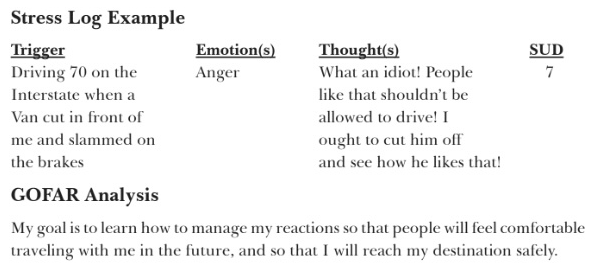
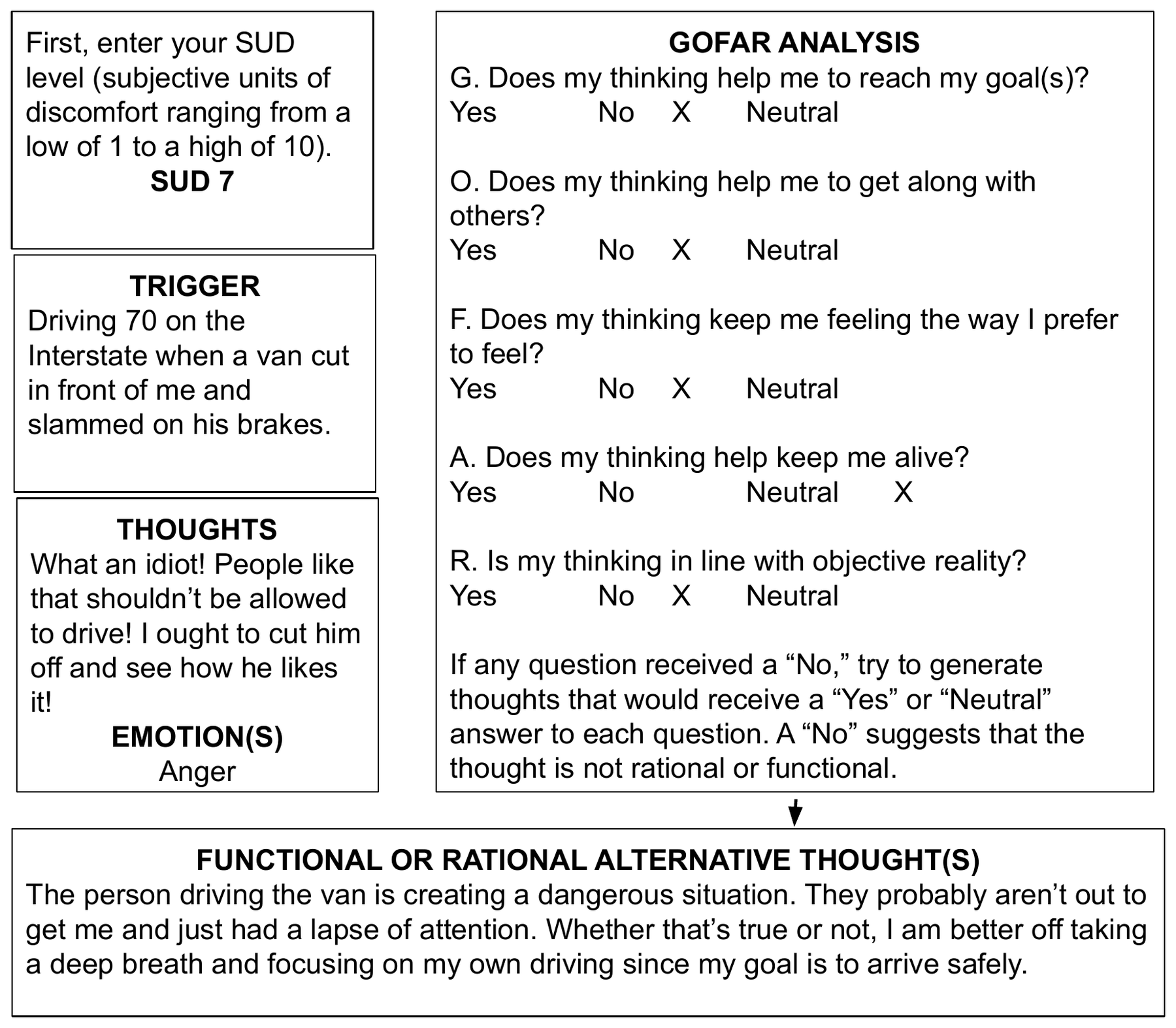
Let’s do an exercise in analyzing thoughts associated with a stressful event. Refer to the form below to follow along with the way clients learn how to use the GOFAR analysis. Assume that I have anxious and angry reactions when driving in traffic, and the result has been that people don’t really want to ride with me. I need to get a handle on my reactions if I want people to ride with me when I drive. The following is an example of how I may begin to identify my irrational thinking. See the figure illustration below the example.
A worked example
Imagine that I was driving seventy miles per hour on the interstate when a van turned in front of me, and the driver slammed on his brakes causing me to brake hard and skid. I felt anxiety and anger. I think, “What an idiot! People like that shouldn’t be allowed to drive! I ought to cut him off and see how he likes that.”
My goal is to learn how to manage my reactions so that people will feel comfortable traveling with me in the future, and so that I will reach my destination safely.
The five criteria, one at a time
The G in the GOFAR analysis represents the word GOAL. My internal test of whether a thought is functional for me is to ask myself the question “Does this thought help me to reach my goal(s)?”
Obviously, I need to know what my goal is in this situation. We often do not stop to think about what our goals are when we encounter stressful events. This is one reason we find it hard to change old emotional reactions. My goal was to get to my destination safely and manage my angry reactions, so the thought, “What an idiot...” doesn’t help me in any way. It is clearly not goal-directed. So, my answer to the first internal test or question is no. I check no in the form below.
The O part of GOFAR represents the word OTHERS. The question “Does my thinking help me to get along with others?” is my next internal test. This is a clear no. My thinking would certainly engender anger or hostility toward the other driver. If I react by yelling or attempting to teach the other driver a lesson by cutting him off, any passengers riding with me will feel uncomfortable or scared by my reaction.
The F in GOFAR represents FEELING. The question is “Does my thought keep me feeling the way I prefer to feel?” Since I don’t like the feeling of anger, my answer to this question is no.
The A in GOFAR stands for the word, ALIVE. The question is “Does my thought help keep me alive?” Let’s assume I don’t act on the thought that I should teach the other driver a lesson by cutting him off. If I am not threatening myself or others, there is probably not a risk of dying, so my answer, in this case, is probably neutral.
The R in GOFAR represents the word REALITY. The internal test is to ask myself the question “Is my thought in line with objective reality?” Is the person an idiot? Technically, an idiot would not be able to obtain a driver’s license. No, the person is not an idiot. Is the person behaving in a manner similar to what I believe an idiot might? Probably, but the person is not an idiot. More likely, the person is a fallible human being. The fact is I don’t know the cause of the person’s driving pattern, and it is simply not functional for me to denigrate the person or upset myself about his driving habits any further.
I have answered all of my internal tests. Reviewing the GOFAR analysis form, I can see that I answered four questions, no, and one question, neutral. For the sake of learning how to think more functionally and rationally, my task is to think in such a way that I will not receive a no answer to any of the five questions making up the GOFAR acronym. Based on my assessment, there is strong evidence that my thinking is clearly not functional or rational for me. If I received even one no, my challenge is the same. That is, to determine what thoughts I need to develop in order to think about this situation in a more functional way.
| GOFAR criterion | Yes | No | Neutral |
|---|---|---|---|
| G — Does this thought help me reach my goals? | No | ||
| O — Does this thought help me get along with others? | No | ||
| F — Does this thought help me feel the way I want to feel? | No | ||
| A — Does this thought help keep me alive and safe? | Neutral | ||
| R — Is this thought in line with objective reality? | No |